

Gallery
Dennis C. Numkena

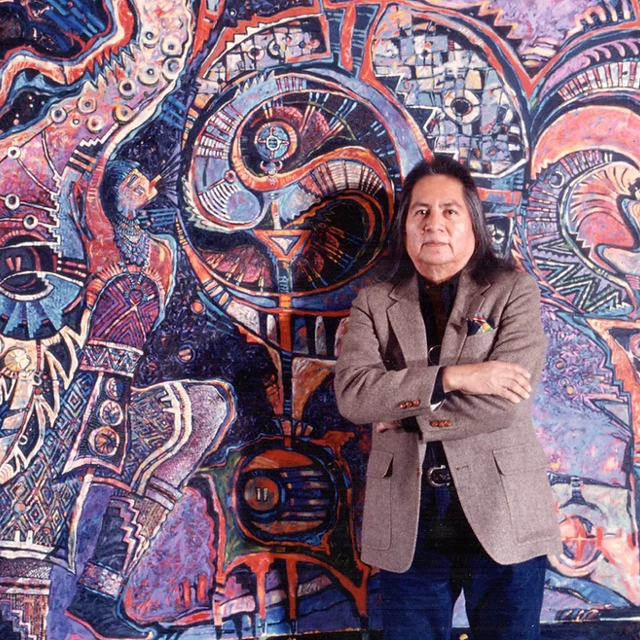
Dennis C. Numkena (1941–2010)
Architect of Memory and Place
Hopi artist and architect Dennis C. Numkena was born in Moenkopi Village on the Hopi Reservation near Tuba City, Arizona. Immersed from an early age in Hopi traditions and the landscapes of the Southwest, he was initiated into tribal responsibilities at age 10, and his passion for art had already begun to take root.
After leaving Moenkopi at 13, Numkena served in the U.S. Army, where he studied computer programming in New York. Following his honorable discharge, he worked as a programmer at Fort Huachuca. He later earned a Bachelor of Arts in Architecture from Arizona State University, becoming widely recognized as the first Native American licensed architect in Arizona.
Pioneering Native American Architecture
In 1970, Numkena founded Numkena Associates, the first Native American-owned architectural firm in the United States. The firm focused on serving Indigenous communities in Arizona and New Mexico, with a commitment to hiring and mentoring Native American architectural talent.
His award-winning projects include:
- Anasazi Resort Condominiums, Phoenix – a clay-red complex of arches, curves, and stepped forms inspired by Chaco Canyon ruins.
- Yavapai Apache Cultural Center, Camp Verde
- Pyramid Lake Museum, Nevada
- Planned American Indian Veterans Memorial, Steele Indian School Park, Phoenix
Numkena described the Anasazi Resort as “the only project that pushed me to the utmost of my capability,” blending modern design with forms reminiscent of ancestral Puebloan dwellings.
Artistic Contributions
Beyond architecture, Numkena was a prolific artist. Beginning in the 1970s, he gained recognition for abstract monotypes and paintings featuring earth tones, vivid color, and imagery drawn from Hopi stories and childhood memory. Animals, dancers, and dreamlike perspectives often appear in his work, reflecting a spiritual connection to the land.
He also designed stage sets and costumes for notable productions, including:
- Arizona State University’s televised Mozart’s The Magic Flute (1982)
- Stage set and murals for Pope John Paul II’s 1987 audience with Indigenous Peoples of the Americas
Philosophy and Legacy
Numkena often referred to ancient builders as his “predecessors,” studying archaeological sites to understand how their architecture might have evolved. “The ruins speak to me in a spiritual way,” he said. “It’s a process of learning – almost as though the spirits were speaking.”
He was honored with the Arizona Indian Living Treasure Award (2002) and the Kent C. Ware Lifetime Achievement Award (2008). Numkena’s work demonstrates that contemporary architecture can honor cultural memory, connect with place, and express deep spiritual meaning – leaving a legacy that bridges history, art, and community.


